
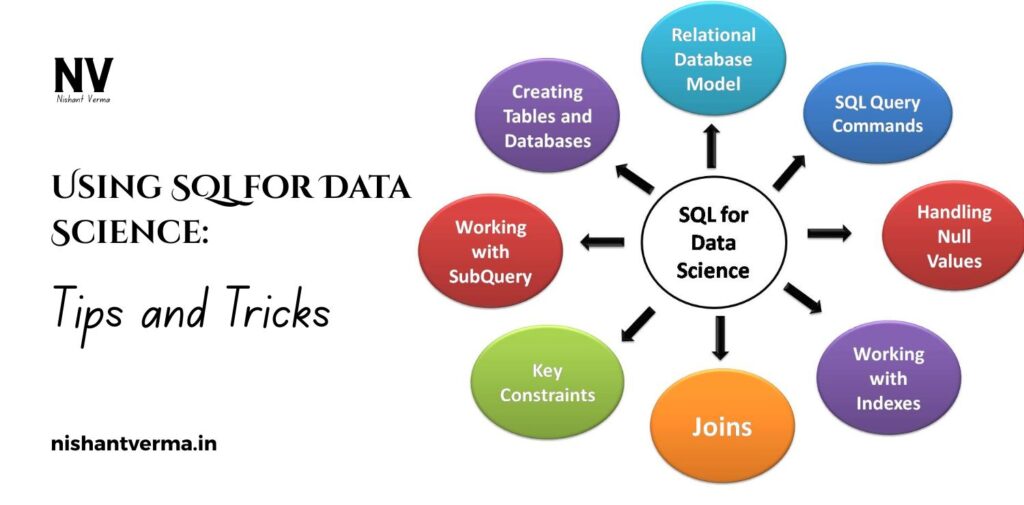
In today’s digital world, data is the new gold. Every small or large business is trying to understand customer behavior, improve their services, and make better decisions using data. This is where data science comes in. And if you are stepping into the world of data science, one tool you must master is SQL – Structured Query Language. SQL is the backbone of data handling and is widely used by data scientists, analysts, and engineers.
In India, with the growing demand for data professionals in IT hubs like Bengaluru, Hyderabad, Pune, and Gurugram, learning SQL can open many doors for jobs and freelance work. So if you’re planning to start your data science journey, here are some useful SQL tips and tricks that will help you become confident and job-ready.
Why SQL is Important in Data Science
SQL is used to interact with databases. Whether you’re working with customer data in an e-commerce company like Flipkart, analyzing sales in a retail business, or managing data in a government project, you will likely deal with large volumes of structured data stored in databases.
As a data scientist or analyst, your job is to extract, clean, and analyze this data. SQL helps you to perform all these tasks efficiently. It allows you to write queries to get the exact data you need, filter it, join multiple data sources, and prepare it for machine learning models or dashboards.
Unlike programming languages like Python or R, SQL is relatively easy to learn and very readable. Even if you’re from a non-technical background, you can learn SQL with dedication and practice.
Learn the Basics First, Don’t Rush
Before jumping into complex joins and subqueries, make sure your foundation is strong. Start with simple SELECT statements, WHERE conditions, and ORDER BY clauses. Understand how to filter data, how to count records, and how to group them using GROUP BY.
One common mistake beginners make is to directly start solving complex problems without knowing what each command does. In SQL, even one wrong keyword or a missing semicolon can break your entire query. So take your time to understand the syntax, practice a lot on sample datasets (like cricket scores, student marks, or sales data), and slowly build your speed.
You can use free platforms like W3Schools, LeetCode, or Hackerrank to practice. Many Indian students also benefit from YouTube channels like CodeWithHarry, Apna College, and Love Babbar’s SQL tutorials.
Master the Art of Joins – They are Super Important
One of the most important and powerful concepts in SQL is the JOIN. In real-world projects, data is not stored in one table. For example, in an online food delivery app like Zomato, the order details are in one table, customer information in another, and restaurant details in a third.
To analyze the complete data, you need to combine these tables. That’s where joins come in – INNER JOIN, LEFT JOIN, RIGHT JOIN, and FULL OUTER JOIN. Each of these joins helps you merge data in different ways.
A good data scientist understands when to use which join. INNER JOIN gives you matching data from both tables, while LEFT JOIN gives you all data from the left table and matching data from the right. These are small things, but they make a big difference in your analysis.
Make it a habit to draw Venn diagrams on paper when you are confused about joins. This trick works for many beginners and makes it easier to visualize the result.
Use Aliases and Comments to Make Your SQL Clean
As your queries become longer, it’s important to keep them clean and readable. This not only helps you, but also helps your team members understand what you are trying to do. Always use aliases (short names) for tables and columns. For example, if your table name is customer_transactions, use ct as an alias.
Also, write comments in your query to explain each step. For example:
— selecting customer ID and total amount spent
SELECT customer_id, SUM(amount)
FROM transactions
GROUP BY customer_id;
Writing clean SQL is a good habit and shows professionalism. In companies, this skill is highly appreciated.
Learn to Use Window Functions – They Can Save You Time
Once you are confident with the basics, start learning window functions. These are advanced functions that allow you to perform calculations across rows that are related to the current row.
For example, if you want to find the top 3 performing students in each class, or rank products by sales within each category, window functions like RANK(), DENSE_RANK(), ROW_NUMBER(), and LAG() are very useful.
These functions are like magic once you understand them. Many SQL interview questions in India, especially in service companies like TCS, Infosys, or product companies like Swiggy, require knowledge of these.
Practice Real-Life Scenarios – Think Like a Business Analyst
Instead of just solving technical questions, try to think like a business person. Suppose you’re working for a mobile recharge company like Jio or Airtel. How will you find out which customer recharges the most? Or which city has the highest number of daily transactions?
Create your own mini projects using datasets from Kaggle or Government of India’s open data portal. Try to answer questions like:
- What is the average monthly expense of a customer?
- Which product category gives the highest profit?
- How has the trend changed in the last 6 months?
Doing this not only improves your SQL skills but also develops your business thinking, which is very valuable in the job market.

Bonus Tips to Keep Improving
Here are a few extra tips to make your SQL journey smoother:
- Don’t memorize – understand the logic behind each query.
- Practice every day – even 30 minutes of daily practice can give amazing results in 2-3 months.
- Join online communities like Stack Overflow or Reddit’s r/learnSQL to get help when stuck.
- Take part in SQL competitions – many Indian platforms like Analytics Vidhya host them regularly.
- Work on your typing speed and attention to detail – SQL is sensitive to spaces, commas, and spelling.
Final Thoughts
SQL is a must-have skill in data science. It doesn’t matter if you’re from a computer science background or not. With dedication and regular practice, anyone can learn SQL. In the Indian job market, where every company from startups to MNCs is looking for data-driven solutions, having strong SQL skills can give you a big advantage.
Don’t think of SQL as just a query language. Think of it as a bridge between raw data and meaningful insights. The better you are at using SQL, the faster and more accurately you can help businesses grow.
So pick up your laptop, choose a good learning platform, and start writing your first SQL query today. The world of data is waiting for you!