
How many of y’all struggled with time management? Especially in a work-from-home setting where time keeps racing and hours slip away just like that? Where time management feels like holding water in the hands. Every day when the clock strikes 4, it leaves you wondering, “What did I accomplish today?”
If this sounds familiar, you’re not alone. Working from home has not only broken the wall between personal and professional life but also hampered the productivity and focus of an individual. Social media temptations, unexpected household chores, and distractions are hard to manage.
But what if I tell you mastering time management while working from home is achievable? The right strategies, discipline, and routine all help you achieve office-like efficiency. A well-known time management technique that breaks work into concentrated bursts known as “Pomodoros” is one of the methods. Let’s explore.
What is the Pomodoro Technique?
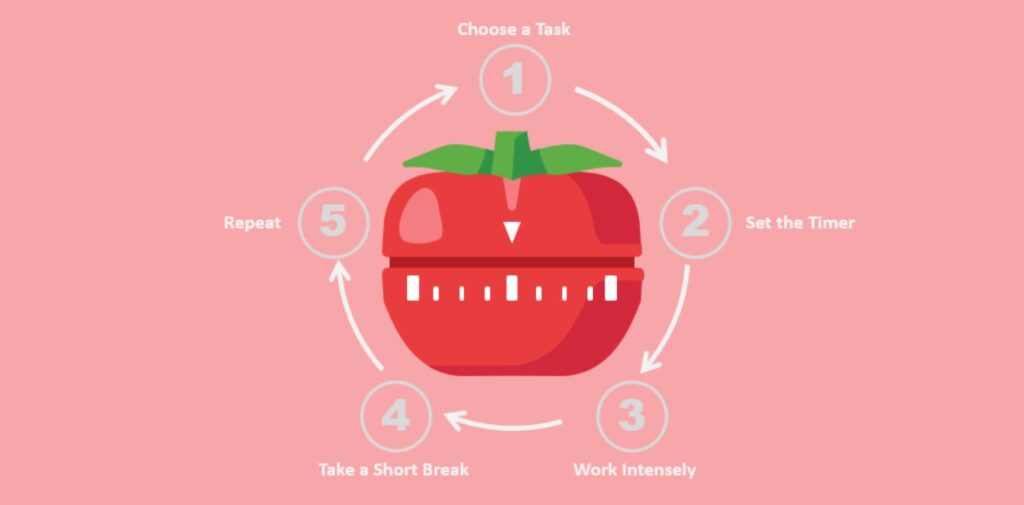
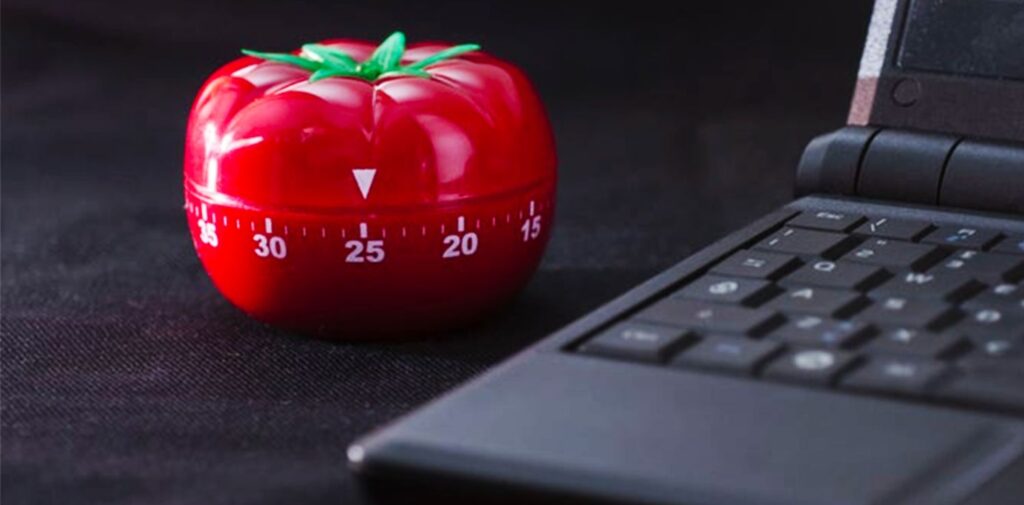
Pomodoro Technique, developed by Francesco Cirillo, is a simple time management technique that aims to divide work into short productive intervals, typically 25 minutes long, followed by a 5-minute break, and a long break after 4-5 cycles. This extended break helps you to relax and recharge before diving right back into work. This helps in maintaining a high level of concentration while preventing burnout. The core principles of the Pomodoro Technique include:
1. Focused Work Sessions: Avoids multitasking – one task at a time with full concentration
2. Short Breaks to Recharge: Curbs mental fatigue, maintains sharp focus
3. Tracking progress: Each Pomodoro represents measurable productivity
4. Reflection and Improvement: Identifying mistakes and focusing on self-improvement.
Why Pomodoro for the remote workers?
The challenges with remote workers are bigger. Pomodoro is no less than a rescue, it’s a way to get work done, the work that comes under the definition of productivity. The benefits of the same are here below.
Enhanced focus – Working from home comes along with distractions, household chores, and family interruptions. A 25-minute block of working helps you maintain absolute focus on work. This technique, when combined with batch working, does wonders. (Batch working, a method where you combine a similar set of work to do in one go to avoid frequent contextual change and distraction.)
Stress Reduction – Short breaks help you reset and freshen up your mind and the whole work environment. This, in turn, helps avoid mental fatigue that ultimately causes stress reduction.
Motivation – Work done in each time block gives a sense of fulfillment & it indeed is a source of motivation to get more done in short intervals.
Task Prioritization – Using the Big 3 technique can also come into play here, where you can identify the tasks that are of high importance & would result in higher productivity

Challenges in applying the Pomodoro Technique
Monotonous – Repeating the same cycle all day, every day might cause boredom or resistance. It then becomes quite a task to stick to the plan.
Constant interruptions – There might be times when it would seem quite impossible to avoid interruptions, pets, family, or unexpected guests. This might lead to the disruption of a well-planned Pomodoro.
Flexibility Issues – There might be some tasks that would require urgent attention, e.g., a work call, that can hamper a Pomodoro.
Apps & Tools for Effective Pomodoro Management
There are several digital tools and apps designed specifically to boost productivity. Here are some of the tools –
Focus Booster – It follows the 25-minute Pomodoro cycles with short breaks. Key features –
- Time Tracking
- Analytics & Reports
- Session Management
Toggl Track – It has a built-in Pomodoro timer, which helps enhance productivity. Key features-
- Visual Time Logs
- Reminders & Alerts
- Integration Support
Pomodone – An advanced Pomodoro timer, integrating tools like Trello, Asana, ClickUp & Jira. Key features –
- Task Integration
- Customizable Pomodoro Length
- Distraction Blocking
Final Thoughts
The effectiveness of the Pomodoro Technique depends on your job nature and personal work style. This technique requires deep concentration. For jobs involving frequent meetings, collaborations, rigid plans, or time blocks might not be of the best use.
However, this technique is adaptable, one can tailor it to their rhythm, significantly enhancing productivity. This technique still holds value in this era, especially in a job that requires creativity and absolute attention. With this technique, you can make a balanced routine. The main aim is to maintain high concentration while reducing burnout.