
In today’s changing business world, every business owner wants to grow and succeed. Whether it is a small shop in Indore, a manufacturing unit in Ludhiana, or a startup in Hyderabad, all businesses need a clear plan to move forward. One simple and powerful tool that can help in making better business decisions is SWOT analysis.
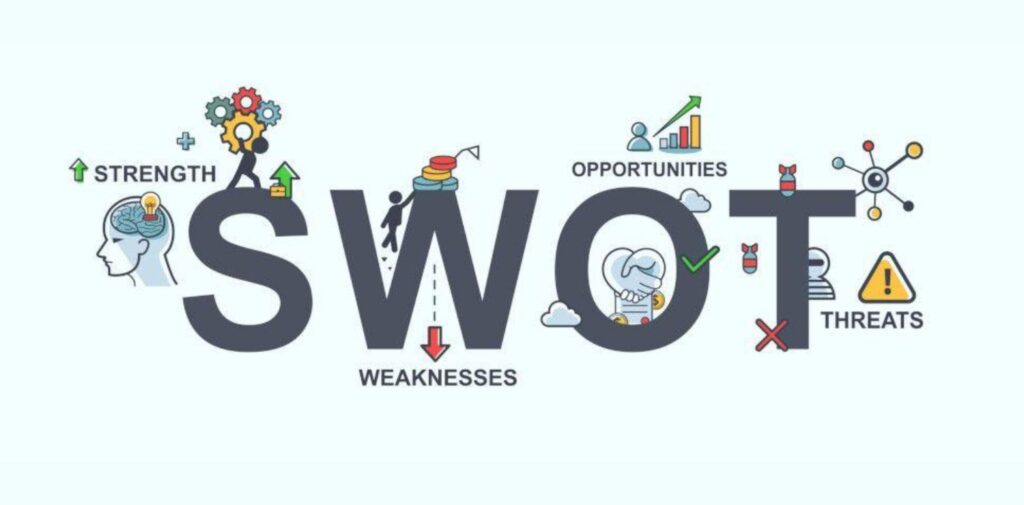
SWOT stands for Strengths, Weaknesses, Opportunities, and Threats. It helps you understand your business better, so you can use your strengths, improve your weaknesses, grab the right opportunities, and stay safe from threats. Let’s understand how you can use SWOT analysis in business management, especially from an Indian point of view, in easy and simple language.
What is SWOT analysis?
SWOT analysis is a method used by businesses to understand their current situation. It is divided into four parts:
Strengths – What your business does well
Weaknesses – Where your business is lacking
Opportunities – What chances you have to grow
Threats – What risks your business faces
This analysis helps you take a 360-degree view of your business. It is like standing outside and looking at your shop or company from all angles to see what is good and what needs improvement. This method is useful for all types of businesses – small, medium, or large.
Understanding your strengths
Every business has some strong points. These are the things that make you better than others in the market. For example, if you run a sweet shop in Kolkata and your sweets are made with pure ghee and traditional recipes, that is your strength. If you run a mobile repairing shop in Pune and you have trained staff, that is a strength too.
Other examples of strengths can be good location, loyal customers, experienced staff, quality products, or strong brand image. During SWOT analysis, list down all your strengths clearly. These will help you plan your marketing and customer service better. Your strengths are your foundation for growth.
Identifying your weaknesses
Nobody is perfect. Every business also has some weak points. These are the areas where you need to improve. It is important to accept your weaknesses honestly. If you hide or ignore them, they may create bigger problems later.
For example, if you run a garment store in Kanpur and your stock management is poor, that is a weakness. If your staff is not trained to talk properly to customers, that is also a weakness. Other examples can include low funds, poor online presence, slow service, or lack of new products.
By knowing your weaknesses, you can start working on them. You can take help from experts, use better tools, or change your business style to overcome them. This will make your business stronger in the long run.

Finding opportunities in the market
Opportunities are chances to grow or do better in the market. These can come from changes in customer demand, new technology, or government policies. For Indian businesses, there are many opportunities today – increasing use of digital payments, growth in e-commerce, support from schemes like Startup India and Make in India.
For example, if you have a small food business in Ahmedabad, you can expand it by offering online delivery. If you are a handicraft seller in Rajasthan, you can sell your products on platforms like Amazon or Flipkart. These are examples of opportunities that come from outside your business.
During SWOT analysis, try to spot such trends and see how your business can take advantage of them. Opportunities help you plan your future strategy and increase profits.
Recognizing threats to your business
Threats are the problems that can harm your business. These can be from competitors, economic slowdown, change in customer taste, or rising costs. For example, if you are a taxi operator in Delhi, app-based cab services can be a big threat. If you sell offline and your competitors are selling online, that is another threat.
Other threats could be new government rules, shortage of raw material, or lack of skilled workers. It is important to prepare for these risks. During SWOT analysis, write down all possible threats and think about how you can reduce their effect.
For Indian businesses, managing threats means staying informed, being flexible, and using smart planning. Insurance, training, and using technology are some ways to face threats confidently.
Using SWOT analysis in daily business decisions
Once you complete your SWOT analysis, the real work starts. You now have a clear picture of your business. The next step is to use this information in your daily decision-making.
For example, if your SWOT shows that your strength is good customer service, you can promote it in your marketing. If your weakness is poor digital presence, you can start working on your website and social media. If you see an opportunity in online selling, you can start building an e-commerce plan. And if there is a threat of losing customers to new brands, you can offer loyalty discounts or improve your product range.
SWOT analysis helps you focus on the right things. It removes guesswork and gives you a direction. Many Indian businesses have used this method to grow, especially after the pandemic, when the market became more competitive.

Involving your team and reviewing regularly
SWOT analysis is not a one-time activity. It should be done regularly – every 6 months or at least once a year. This helps you stay updated and ready for changes. Also, involve your team in the analysis. Your employees, managers, or even your customers can give useful inputs.
For example, your sales team may know what customers like and dislike. Your delivery staff may know what problems happen on the ground. All these inputs can improve your SWOT analysis and make it more practical.
Also, compare your past SWOTs with the current one to see how much you have improved. This creates a sense of achievement and motivates you and your team to keep working better.
SWOT analysis examples for Indian businesses
Here are a few simple examples of SWOT analysis for different types of Indian businesses:
Sweet shop in Lucknow
Strengths – Traditional recipes, loyal customers
Weaknesses – No online delivery, limited marketing
Opportunities – Tie-up with food delivery apps
Threats – New sweet chains entering the market
Online clothing brand in Mumbai
Strengths – Trendy designs, active Instagram page
Weaknesses – No offline store, return issues
Opportunities – Collaborations with influencers
Threats – Fast-changing fashion trends
Tuition center in Chandigarh
Strengths – Experienced teachers, good results
Weaknesses – No online classes, outdated teaching style
Opportunities – Launching video courses
Threats – Competition from online education platforms
Conclusion: A smart tool for business success
SWOT analysis is like a mirror for your business. It shows you your true position in the market. In India’s fast-growing and competitive business environment, using SWOT analysis can help you stay ahead and grow wisely.
It does not require any special degree or technical skill. Any business owner – from a tea seller to a tech startup founder – can use this tool. All you need is some time, honesty, and a notebook or computer.
Start by listing your strengths, weaknesses, opportunities, and threats. Think deeply, take help from others, and create a plan based on your findings. You will see how it brings clarity, saves time, and improves your decision-making.
In the end, running a successful business is not about luck. It is about planning smartly and acting wisely. And SWOT analysis is one of the best ways to do that in a simple and practical way.
Let your business grow with confidence – use SWOT analysis and turn your challenges into opportunities.